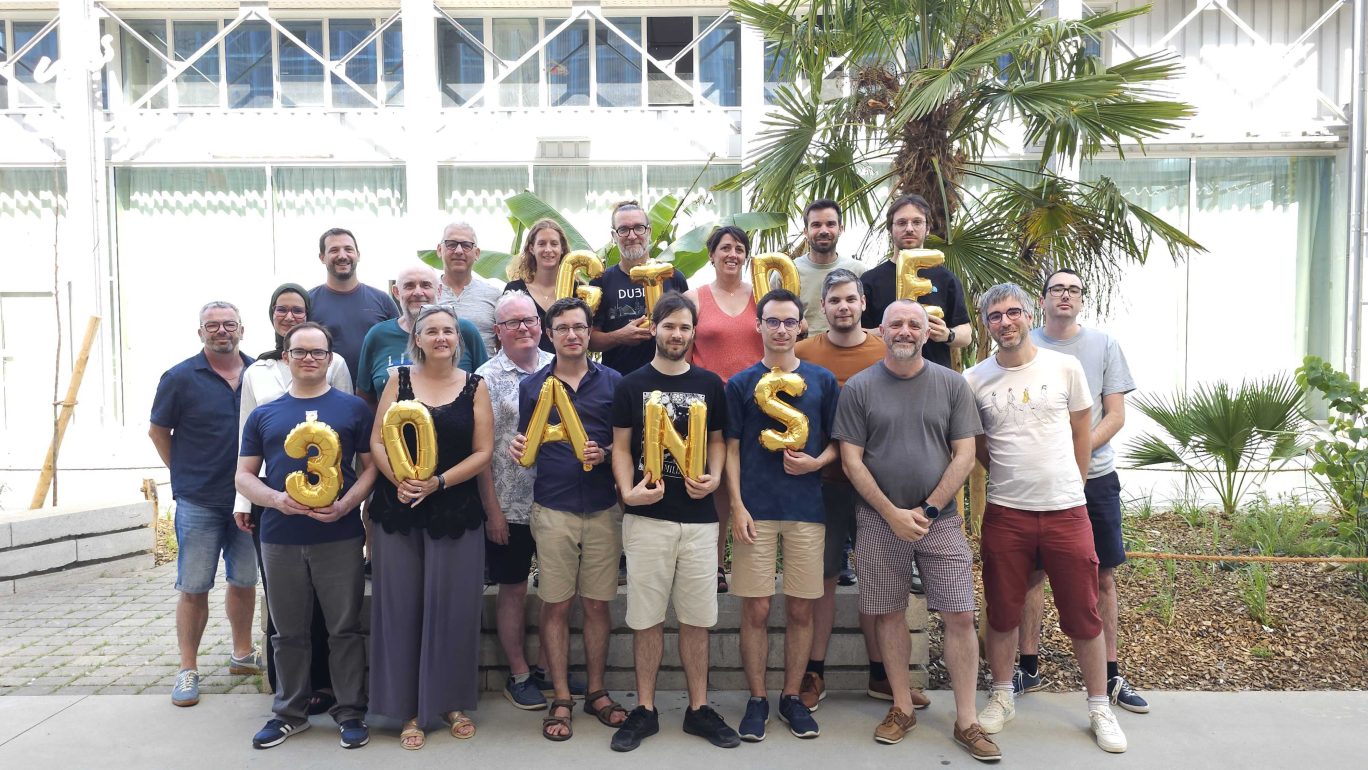
In 2025, GIDE celebrates its 30th anniversary — an opportunity to look back on an extraordinary journey shaped by quiet innovation, long-term client relationships, technical excellence, and a team spirit that spans generations. Since 1995, GIDE has supported organizations working in survey research, from marketing studies to official statistics, while staying true to a founding intuition: automate what can be automated in order to free human intelligence.
Note: The photo illustrating this article was taken recently, but it only shows part of the team!
1995–1998: Born in Nantes, with shared ambitions
It all began with Robert Baldy and Jean-Pierre Moreau, both connected to Sofres (now Kantar). Robert, then a consultant and developer of data reporting tools, dreamed of independence. Jean-Pierre, head of data processing at Sofres, shared the same intuition: it was time to rethink how surveys are designed and produced.
GIDE was founded in Nantes, using technologies that were still largely unknown to research institutes at the time: interactive PDF files, hypertext, and the first web-based reporting tools. From the very beginning, several Sofres colleagues joined the adventure. Enough to trigger a reaction from management… and confirm the departure of a few key talents.
Sofres was strongly opposed to remote work. Yet many people wanted to leave Paris. Several of us decided to take the leap and join GIDE. (Jean-Pierre Moreau)
A little earlier, Robert had created SDA in the UK: our sister company with which we still collaborate daily on shared developments and projects.
1998–2005: The early days of the web, the first turning points
In 1998, GIDE built for Sofres the first online questionnaire ever conducted by French research institutes, and possibly even in Europe. The project was decided during a farewell drink: Microsoft wanted to launch a web survey within seven days. Laurent, 23 at the time, hesitated. Robert said “yes.” It marked the beginning of a new era.
At a time when the internet was still in its infancy, GIDE proposed a scalable approach: describe a questionnaire once, automatically generate the HTML, and guarantee reliable data collection. This expertise firmly established the company as a trusted partner of Sofres, and later OpinionWay, which entrusted GIDE with the development of its entire information system when it was founded in 2000.
At the time, research institutes didn’t even have email addresses. We used to joke that we would give them an internet subscription. (Robert Baldy)
2005–2020: Growing without losing our identity
GIDE continued to grow while maintaining a horizontal organization and strong technical standards. The team expanded, projects diversified, and innovation continued, always with the same objective: to be able to collect and process any type of data, regardless of the conditions or constraints of the project.
For example, to overcome the lack of internet connectivity in certain environments, we have always sought to design solutions that take advantage of the technologies available at the time to ensure that data collection remained possible: “bootable” USB drives capable of running a local web server directly on interviewers’ laptops, deployment of autonomous Wi-Fi mini web servers based on Raspberry Pi devices, and more.
As the web evolved, we adapted our online data collection solution so that questionnaires could run directly in the respondent’s browser or on the interviewer’s tablet, even without an internet connection: data is stored locally and then sent to the server once connectivity is restored. Solutions designed to adapt to real field conditions while ensuring reliability and continuity.
It was towards the end of the 2010s that we began developing SCROLL, our questionnaire creation platform based on our in-house scripting language. The objective was to enable our teams and clients to gain efficiency and autonomy when designing surveys, and to avoid starting from scratch for every new project. Although the platform is still mainly used internally today, it reflects our ambition to structure and share the expertise we have built over the years.
Then came 2020, the year of COVID. Once again we innovated by designing new tools that enabled our clients to continue collecting data, particularly for their face-to-face fieldwork. This led to the development of CAVIsio, a simple 100% web-based solution that makes it possible to conduct remote “face-to-face” interviews: it brings together, in a single browser window, the video of the interviewer, the video of the respondent, and the questionnaire.
To support these development efforts, the team grew from 7 employees in the early 2000s to nearly 20 in 2011, and now includes around 25 people. Our organization evolved accordingly, as Cyril—who joined in 2002 and is still part of the team today—explains:
The team grew gradually, and this steady growth allowed the organization to adapt. Management at GIDE is quite horizontal, but the larger the team becomes, the more important it is to establish a shared framework while preserving the GIDE spirit! (Cyril Dréno)
2020–2025: Entering official statistics, a new chapter
From 2020 onward, GIDE became a key technology partner for official statistics. INSEE initiated a close collaboration with the company around its “new survey infrastructure.” GIDE adapted its questionnaires (programmed with SCROLL) to INSEE’s technical environments, enabling the deployment of more advanced and unconventional survey systems: multilingual audio overlays, voice capture, API-based interactions, and more.
In 2021, we recruited Amélie Bergue to lead our large-scale survey activities. Coming from the research institute world, she discovered GIDE’s technical environment with a real culture shock: moving from Word to a black-and-white terminal straight out of The Matrix!
I felt like I had landed in a movie. Fortunately, the team supported me well as I learned to use the tools. (Amélie Bergue)
One project particularly stood out to her: developing questionnaires integrating speech synthesis, translations, and multiple portals for health surveys.
It’s exciting to see how the right tools can improve accessibility and efficiency in data collection. (Amélie Bergue)
In 2024 and 2025, two emblematic surveys were conducted by INSEE: one among people experiencing homelessness (with DREES), and another on working conditions and psychosocial risks (for DARES).
This marks a real evolution in our positioning. In the past we were very focused on marketing research. Today we are also a recognized partner of official statistics. (Laurent Martin)
Other projects have also emerged in official statistics, particularly large cohort studies in the health sector.
I was particularly struck by the Constances and E3N projects for INSERM, and by the Albane survey for Santé Publique France: large-scale projects in terms of architecture, involving health data hosting (HDS), which led me to change technical stack and start using new JavaScript frameworks. (Cyril Dréno)
A story of expertise, curiosity, and loyalty
Robert perfectly sums up the spirit of GIDE:
What matters are the data that help us understand and anticipate. (Robert Baldy)
Thirty years after the first floppy disk, the original clients are still with us, the tools have evolved, and the team has renewed itself. But one thing has not changed: the desire to deliver real value beyond pure execution.
At GIDE, we don’t just code or host questionnaires. Our strength lies in connecting the right technical building blocks, understanding business, technical, and human constraints, and designing solutions that stand the test of time. This is where our role as a facilitator comes into play—between tools, between stakeholders, and between uses.
What also sets us apart is our proactivity: the ability to step back, advise, and anticipate needs where others might simply execute a specification.
Thirty years later, this posture remains the same: rigorous, curious, and impact-driven. And the pleasure of building things together—seriously but without taking ourselves too seriously—has never left the team.
And tomorrow?
Artificial intelligence is obviously a strategic topic. We see it both as a productivity lever for ourselves (automatic questionnaire generation, development assistance, etc.) and for our clients (AI-driven data collection and analysis, synthetic data, and more). More broadly, the increasingly central role of data requires thinking beyond the questionnaire itself, connecting multiple data sources and enriching survey systems. One of our priorities is to avoid limiting ourselves to the questionnaire layer, but instead to continue anticipating change, innovating around data, and integrating AI intelligently.
What we do in three days today, we might be able to do better and in just a few hours tomorrow thanks to AI. The challenge is to focus on what truly creates value. (Laurent Martin)
Faithful to its original vision—innovating and automating in order to think better—GIDE intends to remain a key partner for research institutes and public organizations. In France today — and perhaps internationally tomorrow.